SURFACEMON

External attack surface management and cyber threat intelligence on one platform.

All it needs to start is your domain name; nothing to install.

$ surfacemon --scan example.com --full
[✓] Discovering attack surface for example.com...
[✓] Found 124 subdomains, 48 IPs and 14 cloud assets
[✓] Fingerprinted 37 web technologies (8 outdated)
[!] 23 open TCP services, 2 databases exposed to the internet
[!] 3 SSL certs expiring · no WAF on 9 subdomains
[!] PoC exploits for 2 issues (1 Critical, 1 High)
[!] 9 CVEs matched to your tech stack this month
[✓] Scanning darknet for credential leaks...
[!] 78 employee accounts in stealer logs & combolists
[!] 312 leaked passwords for login.example.com
[!] 5 look-alike domains imitating example.com
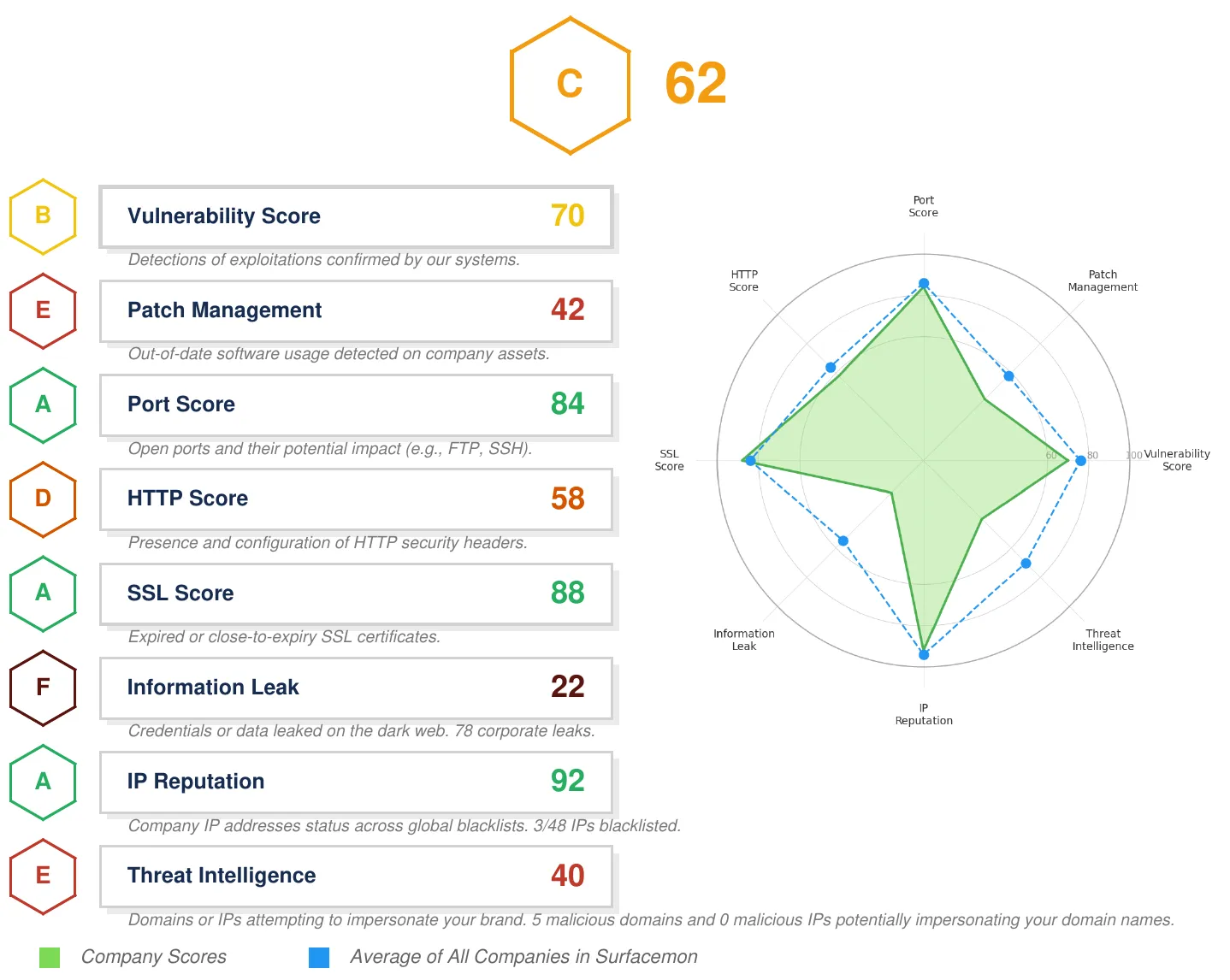
[i] Security score 62/100 · below platform average
[i] AI insights & remediation steps ready on surfacemon.io

What is SURFACEMON?

A security platform engineered in Türkiye that shows your organization’s internet-facing side the way an attacker would see it.

Every organization has an internet-facing side: domains, servers, cloud services, certificates, open services. Some of it gets forgotten, some of it was never on record. That is exactly where attackers look first.

SURFACEMON does two jobs on one platform. External attack surface management (EASM) finds every asset reachable from the internet, keeps an inventory of it and watches it for vulnerabilities. Cyber threat intelligence (CTI) follows what happens outside that could target you: leaked passwords, look-alike domains, ransomware announcements.

Your domain is enough
To start, you only register your organization’s domain name; SURFACEMON discovers the rest.
Nothing to install
It runs as a cloud service (SaaS); no software or agent goes onto your systems.
Continuous monitoring
Scans repeat on a regular basis, so new assets and new findings show up as they appear.
Engineered in Türkiye
Built entirely by CenterOnDigital engineers and exported abroad. Customer data stays in Türkiye.

Three pillars, one platform

Finding your assets, watching outside threats and assessing your supply chain don’t need separate tools.

Asset inventory & vulnerabilities

Starting from a single domain, it finds your subdomains, IP addresses and cloud assets. It identifies the services and web technologies running on each, matches them against known vulnerabilities and PoC exploits, and shows gaps in certificates, HTTP headers, WAF coverage and HTTPS redirects.

  • Subdomains
  • IPs
  • Web technologies
  • TCP services
  • Cloud assets
  • SSL certificates
  • CVE / PoC issues
  • HTTP headers
  • WAF & HTTPS checks

Threat intelligence

It monitors dark web leaks of your corporate accounts and tells their source apart: stolen by malware (stealer logs) or taken from a compiled list (combolists). It finds third-party breaches, botnet leaks and domains imitating your brand, and gathers ransomware announcements, IOC lists and CVEs for your own stack in one feed.

  • Dark web leaks (stealer / combolist)
  • Third-party breaches
  • Botnet leaks
  • Look-alike domains
  • Ransomware feed
  • IOC feeds
  • CVEs for your stack
  • AI news feed

Supplier assessment

It doesn’t scan your suppliers’ networks; it brings them in through assessment forms. You build your own form or start from a template. Each supplier fills it in section by section and attaches evidence, and their answers produce risk scores. Completed forms download as one file with the PDF and attachments. It supports KVKK, ISO 27001 and NIST compliance with evidence-based evaluation.

  • Supplier forms
  • Risk scores
  • Evidence export
  • KVKK / ISO 27001 / NIST

AI insights

Understanding what a finding means matters as much as finding it.

SURFACEMON’s AI assistant works on the detail page of each finding for PoC exploit issues, HTTP header security and domain assets. It explains the finding in plain language and suggests where your team should start.

It weighs different issues on the same asset together, showing how findings that look minor on their own can add up to a bigger risk.

AI also works on the threat intelligence side: it filters cybersecurity news from many sources and brings forward what is relevant and significant.

For each finding

  • Explanation: What the issue is and why it matters.
  • Impacts & risks: What could happen if it is exploited.
  • Combined risk analysis: The risk it forms together with other findings on the same asset.
  • Prioritised remediation suggestions: A suggested order for the steps to take.
  • Possible consequences: What you may face if the finding is left open.

Suggestions support your team’s decisions; the AI doesn’t change anything itself. AI can make mistakes, so suggestions should always be double-checked.

How it works

Three steps from the moment you register your domain.

  1. Discovery

    Starting from your domain, SURFACEMON finds the subdomains, IP addresses and cloud assets connected to it.

  2. Inventory & score

    Each asset’s services, technologies, certificates and leaks are scanned. A security score is calculated per domain and for the company, and compared with the platform average. A few critical findings don’t get hidden behind many secure assets.

  3. Prioritising & planning

    Findings are ranked by severity. With AI suggestions, alert rules and reports, your team plans the remediation and tracks progress.

Reporting & integrations

Findings don’t stay on the screen: they reach management, your team and your IBM QRadar.

Security scores page of a SURFACEMON executive summary report: overall grade and score, eight sub-scores and a radar chart comparing the company with the platform average.
From an executive summary report: scores compared with the platform average (demo data).
Executive summary & full reports
PDF reports sum up the scores in a radar chart with short explanations and include monthly score graphs. Sections without findings are left out.
Scheduled reports
Reports are delivered automatically at the intervals you set; each schedule shows when it last sent and when it sends next.
Score history
Follow your domain and company scores month by month, compare them with the platform average and save the graphs as images.
Alert rules
Set rules for events such as SSL certificates about to expire or newly leaked passwords; triggered alerts get a page of their own.
IBM QRadar integration
Security alerts stream straight to IBM QRadar over mTLS-secured Syslog, with a step-by-step setup guide for the LEEF mapping in the platform.
CSV export
Download table data as CSV; reorder, hide and resize columns.
Email two-factor authentication
Protect your account with a code sent to your email at every login.

See your attack surface before an attacker does

Visit surfacemon.io to request a demo and learn more.

Visit surfacemon.io (opens in a new tab)